[This article by Matthew A. McGuire was originally published in the August 2026 issue of The Iowa Lawyer magazine.]
The last four Iowa Supreme Court terms—from the 2022-2023 term to the recently concluded 2025-2026 term—have seen a stylistic shift in how the Court articulates its rulings. Brevity has become the order of the day. Not only have the Court’s opinions become shorter on average, but even factoring in those fractured rulings involving separate opinions, the Justices are using fewer words to say what they wish to say.
Opinions by the Numbers
The 2025-2026 term of the Iowa Supreme Court concluded on June 30. While it might seem straightforward to simply count the number of cases decided by the Court, there are different ways to measure the output of a term. The Court released 107 published decisions, decided 106 cases, released 105 majority opinions, and yet only decided 104 cases by opinion. This term involved a unique situation in which one appeal—City of Davenport v. Office of Auditor of State of Iowa, No. 24-1160—resulted in the release of two opinions: one divided opinion released in December 2025 regarding an appellate procedural issue, and one unanimous opinion released in April 2026 on the merits. Two other appeals were divided 3-3, resulting in the underlying judgment being affirmed as a matter of law. However you want to count it, the Court’s output level was right in line with the last few terms.
Including dissenting, concurring, and per curiam opinions, the Court issued 149 total opinions, a slight increase from the last few terms. In particular, the justices collectively authored 20 concurring opinions, compared to an average of 13 since the Court gained its current composition in the 2022-2023 term. Justice Mansfield issued the greatest number of opinions this term, including eight dissenting opinions and 12 separate opinions overall. However, the number of non-unanimous cases, 23, was consistent with the last few terms. So was the number of closely divided cases, which was 13.

This term featured a dramatic discrepancy in reversal rates between the Iowa Court of Appeals and the district courts. The Court of Appeals was fully affirmed in only 22% of appeals from that court, with full reversals in 62% of appeals and a mixed disposition in the remaining 16%. District court rulings, by contrast, were affirmed in 49% of appeals. There tends to be a slightly higher reversal rate on appeals taken on further review from the Court of Appeals, likely due to an adverse selection effect reflecting the types of cases likely to be selected for further review. Nevertheless, this is the highest spread we have seen in recent history.

This term, nearly all of the Supreme Court’s cases came from the two traditional sources of jurisdiction: 51 cases heard on direct appeal and 45 cases heard via further review. The Court only heard one case via discretionary review, three cases via interlocutory appeal, and three cases via certiorari. The Court also decided two attorney discipline cases and one certified question from a federal district court. These figures stand in marked contrast to last year’s mere 33 direct appeals and 22 appeals combined via discretionary review, interlocutory appeal, or certiorari.
The Supreme Court decided 28 criminal cases and 78 civil cases. Though the ratio of civil cases to criminal cases has been gradually trending higher over the years, this is the highest ratio of civil cases to criminal cases since at least 2020.

Finally, 84 of the Court’s 107 published decisions were unanimous. This rate of 78% unanimous decisions is right in line with the historical average for the Court in its current composition. From the 2022-2023 term onward, the Court’s unanimous decision rate has ranged between 77% and 81%.
Length of Published Opinions
The published opinions of this term’s Court totaled 2,118 pages. While that may seem like a colossal amount of verbiage, it pales in comparison to the 3,135 pages of opinions the Court released only four years ago, during the 2021-2022 term. The shift to the current composition of the Court, beginning with the 2022-2023 term, has heralded an era of relative economy. Between the 2018-2019 term and the 2021-2022 term, the average Supreme Court ruling, encompassing all separate opinions but excluding opinions released per curiam, totaled 27.2 pages. Between the 2022-2023 term and the most recent term, another four-year span, the average ruling totaled 20.2 pages—a 25% decrease in length.
An astute reader might suspect that this decline would be attributable to the contemporaneous decrease in separate opinions and non-unanimous opinions catalogued in statistical overviews of prior terms in this magazine. This probably explains some of this statistical effect. A majority opinion that does not need to respond to a dissenting opinion may not need to say as much. But the Justices’ individual writings are getting shorter as well. The average individual opinion issued between the 2018-2019 term and the 2021-2022 term, inclusive of all concurring and dissenting opinions measured separately, was 17 pages. During the past four terms, that figure is 15 pages—a smaller, but nevertheless distinct, decrease.
This shift in writing style has manifested itself at both ends of the statistical spectrum. The outlier opinions are shorter, but so is the median opinion for each term. Each of the four terms between the 2018-2019 term and the 2021-2022 term featured at least one ruling totaling over 100 pages, inclusive of all separate opinions. The Court has only published one 100-page ruling since. The median opinion length has also steadily declined, with this most recent term featuring the shortest median opinion (16 pages) of the past eight years.

Frequency of agreement
This term’s justice alignment data stands out in at least three ways. First, the range of agreement percentages is wider than it has been since the Court obtained its current composition. While the data still shows most justices agreeing with each other between one-third and two-thirds of the time in divided cases, the average range of each justice’s alignment metrics—the discrepancy between the justices’ highest and lowest agreement levels—is 25% higher than it was last term. The Court’s collective standard deviation—a measurement of the distance of each agreement level from the average—also increased moderately term-over-term.
Second, this most recent data shows a relative lack of agreement among Chief Justice Christensen, Justice Waterman, and Justice Mansfield. These three justices have been the closest the current Court has come to a set of justices voting together reliably over the last few terms. Justices Christensen and Mansfield agreed with each other only 52% of the time in divided cases: by far that pair’s lowest agreement figure. And Justices Waterman and Mansfield, who have frequently been the two justices most likely to agree with one another, agreed on fewer than two-thirds of divided cases this term. That is also an all-time low value for the period for which we have alignment data.

Third, there are two trends involving Justice May worth noting. One, Justices McDonald and May have, for the second time in three terms, been the justices who have agreed most frequently. This term, that value was 91%. And two, Justice May, also for the second time in the most recent three terms, was the justice most likely to appear in the majority in divided cases: also 91% of the time. Justices Oxley and McDermott were most likely to author or join dissenting opinions, siding with the majority only 52% of the time in divided cases.
Justice alignments in closely divided cases
There were 13 “closely divided” cases this term, where a change to one vote would have changed the result. The most common four-justice majority was comprised of Justices McDonald, Oxley, McDermott, and May, who joined as a majority to decide three such cases. This, like some of the alignment data identified above, is a return to a pattern that emerged in the 2023-2024 term. This term, Justices McDonald and May were far most likely to sit with the majority in closely divided cases, at 82% and 80% respectively.
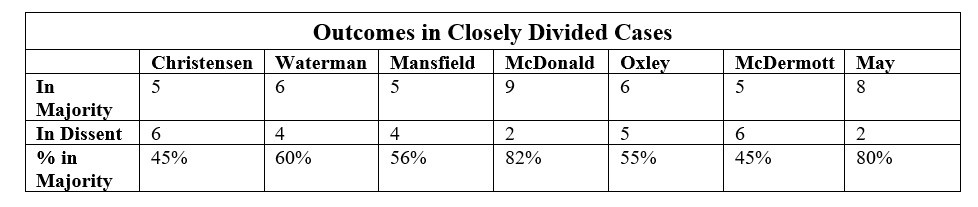
We caution readers against drawing too much from these small sample sizes, however. In prior statistical overviews, we have speculated whether the data was showing that Justices Oxley or McDermott were acting as a decisive “swing vote.” In reality, the safest takeaway from this data is that the outcomes and lineups of divided cases remain unpredictable.
The post A statistical review of the 2025-26 Iowa Supreme Court term: “The Incredible Shrinking Judicial Opinion” appeared first on Nyemaster Goode On Brief.